
USA-209. A WHO Collaborating Centre for Eugenics and the Bernard Moss Patents
CONSTRUCTING HYBRID VIRUSES since 1988 from VACCINIA (AKA SMALLPOX VIRUS)

This article is based on a two-year investigation into WHO Collaborating Centres by WCH Australia’s Lucinda van Buuren.
For most people, smallpox vaccination belongs to history books. The “success” of the small pox vaccination programme is often given as justification for the burgeoning vaccination schedules and industry. Thus, it remains little known that smallpox vaccination was harmful and caused far more disease than it prevented.
You can read more about similarities between the small pox “pandemic” response and the Covid-19 “pandemic” response in a book by Dr Suzanne Humphries and Roman Bystrianyk called Dissolving Illusions. The genetic material in the smallpox vaccine is called VACCINIA or vaccinia virus. Whatever vaccinia virus is, it’s biologically peculiar and its exact origins remain in question. Scientists have noted that whilst it is related to cowpox and horsepox, it appears genetically distinct from both. Wherever vaccinia is from, its potential utility as the foundational engineering platform of eugenics has become manifest through the investigative work of WCH Australia’s Lucinda van Buuren that follows.
Vaccinia: The Engineering Platform of EUGENICS?
It appears that by the 1980s and 1990s, the vaccinia virus was recognised as a good candidate for genetic engineering, because it had a very large genome and the ability to accommodate inserted genes. This made vaccinia an ideal “viral vector”, i.e. a virus used to deliver genetic instructions from entirely different pathogens.
Few figures are more central to the engineering of vaccinia (smallpox virus) than Dr. Bernard Moss of the U.S. National Institute of Allergy and Infectious Diseases (NIAID).

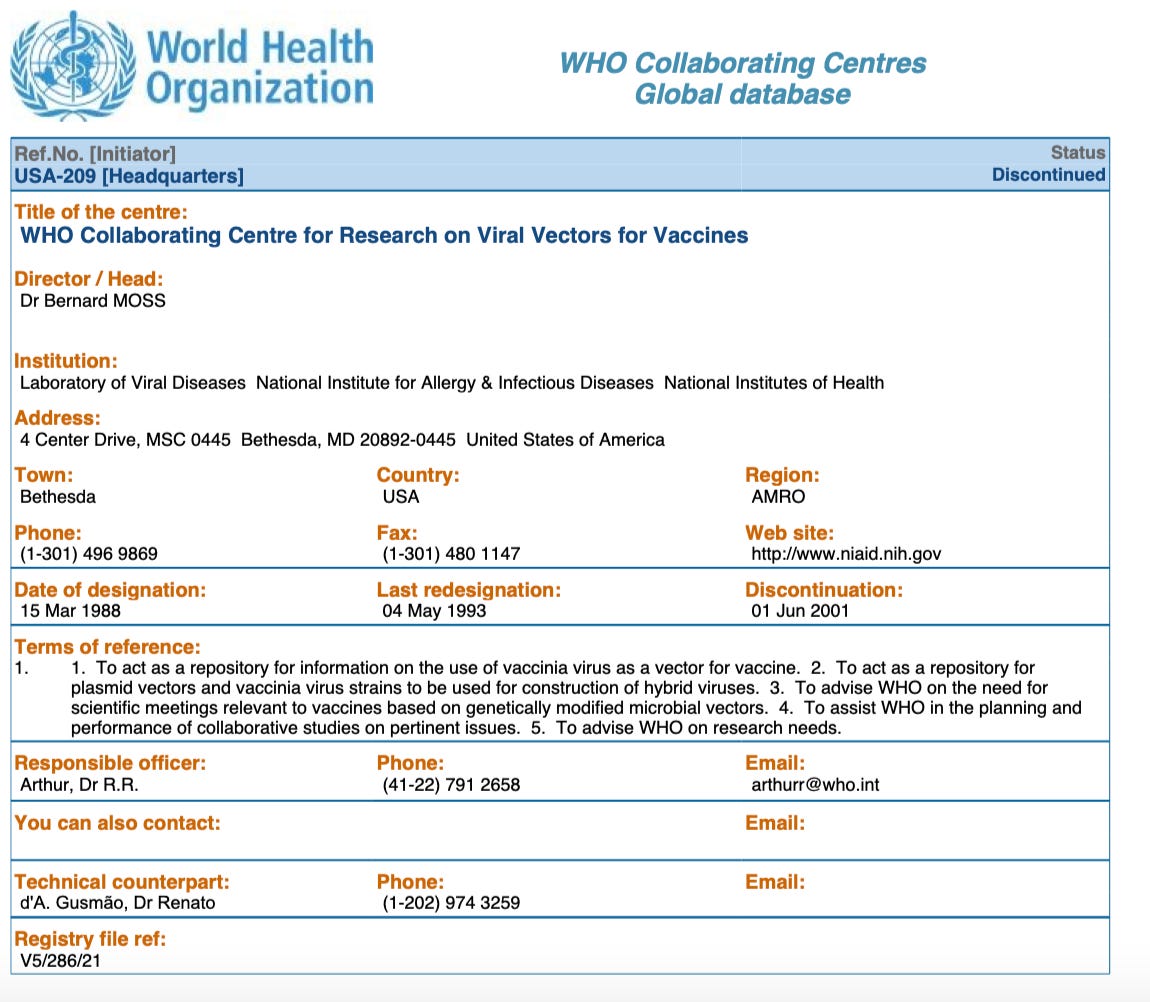
From 1988 to 2001, Moss headed the WHO Collaborating Centre for Research on Viral Vectors for Vaccines. “Vaccines”, it turns out, can be (or are) based on of laboratory-selected genetic material cut and pasted together.
The WHO Collaborating Centre’s formal terms of reference are striking when read today. They include that the NIAID WHO CC under Dr. Bernard Moss would:
act as a repository for vaccinia virus strains,
maintain plasmid vectors,
construct hybrid viruses,
advise WHO on genetically modified microbial vectors,
and coordinate collaborative studies on engineered vaccine systems.
Engineering a Biological Operating System for Foreign DNA: The Rise of Recombinant Vaccinia
A pathogen is defined as any organism or agent, such as a virus, bacterium, fungus, or parasite, that causes disease in its host. From the Greek pathos (suffering) and genēs (producer of) it means “producer of suffering”.
With vaccinia as a viral engineering platform, NIAID’s Moss and colleagues have inserted genes from rabies, HIV, influenza, hemorrhagic fever viruses, and many other pathogens into vaccinia and other poxviruses in the context context of vaccine research and development. The rabies vaccine (Raboral-VRG) was in fact one of the first recombinant vaccinia vector vaccines, engineered to carry the rabies virus glycoprotein gene.
The WHO and this USA Collaborating Centre led by Moss at the NIAID appear to be deeply involved in organising and standardising the development of this biological operating system designed to introduce foreign DNA into living creatures - humans, animals, plants, etc.
Hybrid virus construction and genetically modified biological carriers have little to do with medicine, healing, or preventing disease. So why is the WHO and the NIAID overseeing programmable vaccinia viral delivery systems? These “producers of suffering'“ are so sought after these days that there are negotiations over pathogen access and benefit sharing (PABS) in the WHO Pandemic Treaty!
Customisable Genetic Delivery Machines
The patent trail associated with Moss reveals much about what this technology may be used for. Repeatedly, the Moss patents focus on inserting exogenous DNA, restructuring viral genomes, altering inter-genic regions, engineering expression profiles, genomic programming, and optimising recombinant gene activity. Simply put, the focus of this work is on redesigning viruses (engineered bits of genetic material) to behave as customisable genetic delivery machines.
A most popular example of viral vectors is recombinant Modified Vaccinia Ankara (MVA), an engineered live vaccinia virus containing restructured insertion sites turning the virus into a modular platform. The Moss patents related to MVA effectively describe where to cut, where to insert, how to stabilise the genome, and how to optimise expression of foreign genetic material.
Providing a modular and expandable architecture, engineering viral vectors seems to me to be a bit like LEGO. in biological terms, however, the term “insertion sites” mean that these engineered viruses become programmable vehicles for genetic payloads.
Vaccinia Vectors as Vaccines for Biowarfare
The MVA viral vector is used in smallpox vaccines, which are also deployed for monkeypox (now called mpox) (ACAM2000, and Jynneos vaccines), and Ebola vaccines (Mvabea). Despite being eradicated, smallpox vaccines continue to be stockpiled for biodefence reasons. The platform was explored for COVID-19 but did not become the dominant commercial method because mRNA and adenovirus platforms scaled faster.
There are no widely licensed HIV vaccines, nevertheless vaccinia vectors have been heavily studied for decades in HIV Research as evidenced by the Bernard Moss patents: many involve recombinant MVA expressing HIV env, gag, and pol genes. (e.g. US Patent 8916172 and US Patent 9453239). That HIV genes seem to be used in vaccine vectors, plasmid systems and genetic products is worthy of exploring in a separate article.
What strikes one upon searching these patents and others is that MVA platforms have been engineered for everything under the sun (or constructed in a biowarfare laboratory) including
Hantavirus, Andes virus, Sin Nombre virus
Measles
Influenza including avian influenza and H5N1 influenza
Parainfluenza
RSV
Dengue
Yellow fever
Japanese encephalitis
West Nile virus
Cytomegalovirus (CMV)
Epstein–Barr virus (EBV)
Herpes simplex virus (HSV)
SARS-CoV-1, MERS, SARS-CoV-2 (experimental MVA coronavirus vaccines were developed before and during COVID-19)
HIV
Hendra virus
Zika virus
Chikungunya
MERS
Nipahvirus
Hepatitis B and C,
and haemorrhagic fever viruses, including:
Crimean-Congo Hemorrhagic Fever
Rift Valley fever
Lassa fever
Junin virus
Machupo virus, and
Marburg.
It has also been used in laboratory product research and development as a vector to carry bacteria and parasites including:
Tuberculosis
Anthrax
Plague
Leishmaniasis
Toxoplasmosis and
Malaria.
In collaboration with NIH, NIAID, it is clear that DARPA and military biodefense programs are heavily invested in this work. Hantavirus MVA products, for example, have been a biowarfare focus for 40+ years (e.g. see GeoVax Labs in Atlanta, Walter Reed Army Institute of Research, U.S. Army Medical Research Institute for Infectious Diseases facility on Fort Detrick).
The Bigger Pattern
Reading the patent literature over time, a clear pattern emerges. The field gradually moved from studying pathogens to sequencing pathogens, then cloning genes, then inserting those genes into vectors, then optimizing expression systems then redesigning viral genomes themselves. Vaccinia is one of the earliest large-scale examples of this transition.
Once viruses become modular engineering platforms, the conceptual distinction between vaccine, vector, recombinant construct, and engineered virus
becomes increasingly blurred.
This is the story of how the vaccine becomes the pathogen and why they are best understood as engineered stealth weapons.
Vaccinia may ultimately prove to be one of the most toxic organisms in the history of biotechnology. It established the blueprint for how to surreptitiously degrade the human genome and selectively cull humanity without being caught - that is, until now.
References
WHO Collaborating Centre USA-209 terms of reference (1988–2001) (above)
Bernard Moss patents: P1-4 below;

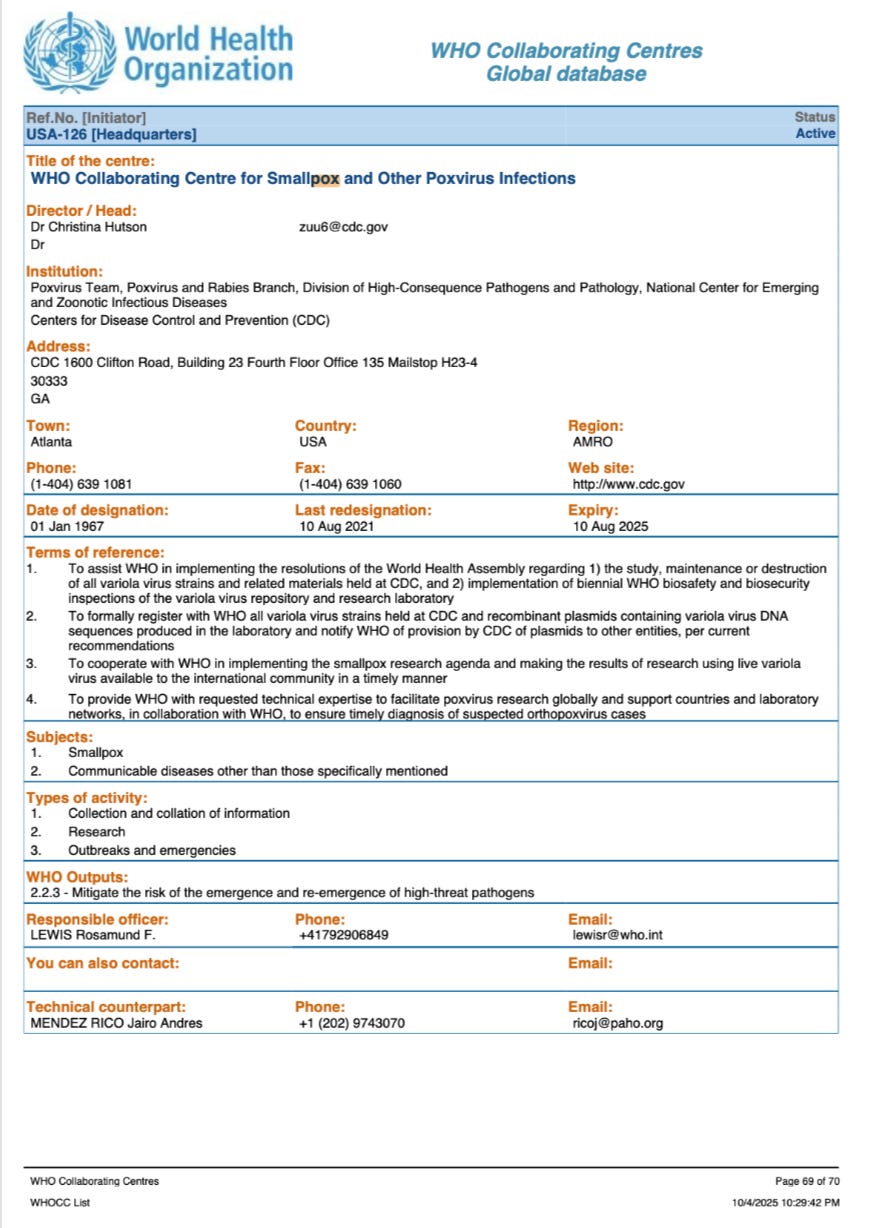
Whilst USA-209 WHO CC was discontinued in 2001, others are going strong, for example USA-126 WHO Collaborating Centre for Smallpox and Other Poxvirus Infections, engaged since 1967. Let’s save these for discussion another time:
You may also wish to read this post about smallpox from 2023.
Small pox vaccination caused small pox. Covid-19 vaccination caused ?

In 1875, people in England were fortunate if they received the following postcard and heeded its advice. It provided four sound reasons not to have one’s children vaccinated with the small pox vaccine.